Ready to upgrade your clinical practice with cutting-edge ECG technology?
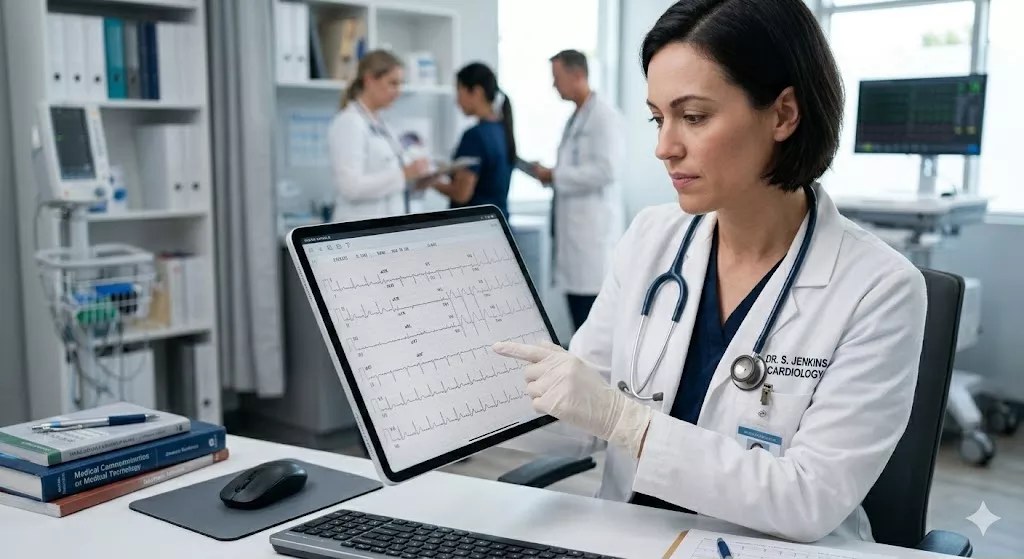
Beyond the Holter
How Wearable ECG Tech Is Putting Cardiac Care in Patients’ Hands
🩺 Quick Summary: The Cardiac Revolution
Healthcare systems worldwide are shifting toward “care-at-home.” Wearable ECG tools now let cardiologists monitor heart health in real-time without disrupting a patient’s daily life.
- Wellysis S-Patch ExL: An 11g feather-light patch for continuous monitoring up to 14 days.
- CardioSecur Pro: Mobile 22-lead ECG for hospital-grade diagnostics anywhere.
- Freedom for Patients: Users can work, sleep, and shower normally without bulky Holter wires.
Healthcare systems worldwide are under pressure to deliver high‑quality care without overflowing emergency departments or straining overburdened hospital beds. Remote‑patient‑monitoring tools—especially wearable ECGs—now let cardiologists “see” inside the heart from a distance, while patients keep working, sleeping, and showering as usual. For providers and patients alike, this means fewer avoidable admissions, earlier detection of arrhythmias, and more personalized treatment plans.
Wearable ECG technology is no longer a novelty; it is becoming standard follow‑up care for patients with atrial fibrillation, post‑procedure monitoring, and unexplained palpitations. What is changing is the experience: instead of bulky Holter boxes and electrode‑filled vests, patients now wear feather‑light patches or pocket‑sized devices that transmit data in real time to a clinician’s dashboard.
The Downsides of Traditional Holter Monitoring
For decades, the gold standard for ambulatory ECG monitoring has been the Holter recorder—a small box connected by multiple leads to electrodes on the patient’s chest. While accurate, it comes with well‑known drawbacks: the equipment can be uncomfortable, visibly intrusive, and disruptive to sleep and daily activities. Patients often avoid showering, hesitate to exercise, and may remove leads out of discomfort, risking incomplete or “patchy” data capture.
In practice, this means that brief, intermittent arrhythmias—precisely the ones most likely to escape detection—can still slip through the recording window. Moreover, interpreting days of raw Holter data is time‑consuming, and clinicians typically receive reports only after the patient returns the device. By that time, the clinical context of that skipped heartbeat or syncopal episode may already be lost.
Wellysis S-Patch ExL: Monitoring Without the Clutter
Avittia’s Wellysis S-Patch ExL embodies the move from “monitoring as burden” to “monitoring as background.” Weighing just 11 grams—about two sheets of printer paper—the patch is designed to be almost forgotten once applied. It can be worn comfortably for up to two weeks, through showers, sleep, and normal physical activity, thanks to its adhesive, waterproof design.
Unlike classic Holter recorders, the S-Patch ExL streams ECG data continuously to a paired smartphone or cloud‑based platform, giving clinicians access to 100% of the recording. This allows specialists to correlate symptoms—such as sudden palpitations or dizziness—with precise ECG traces, even if the patient does not remember the exact moment.
CardioSecur Pro: Bringing 22‑lead ECG Anywhere
If the S-Patch ExL is about continuous monitoring, CardioSecur Pro is about bringing hospital‑grade diagnostics to the point of care. It is a mobile 22‑lead ECG system that uses only four electrodes to generate a 360‑degree view of the heart’s electrical activity.
This design is particularly valuable in emergency settings. Studies suggest that 22‑lead ECGs can significantly improve the detection of myocardial ischemia compared with standard 12‑lead traces. In prehospital environments, CardioSecur Pro can alert teams to ST‑elevation myocardial infarction (STEMI) earlier, enabling faster triage.
| Benefit | For the Patient | For the Provider |
|---|---|---|
| Comfort | Freedom to move, sleep, and shower. | Higher patient compliance rates. |
| Data Access | Fewer clinic visits required. | 100% data capture via Cloud integration. |
| Diagnosis | Faster detection of abnormalities. | AI-driven flags for high-priority events. |
The Rise of “Care‑at‑Home” in Cardiology
The broader trend is the shift from hospital‑based to home‑based care. Remote‑patient‑monitoring platforms now integrate multiple parameters—ECG, heart rate, blood pressure—into unified dashboards. For patients, “care‑at‑home” is about more than convenience. A 2025 European Medical Journal report noted that 79% of emergency teams preferred CardioSecur Pro over traditional ECGs due to rapid results.
Why Cardiologists Should Embrace These Tools
Wearable ECG devices augment clinical acumen. By providing context‑rich data, they allow clinicians to:
- Identify infrequent arrhythmias that would escape a 24-hour Holter.
- Correlate physical symptoms with precise electrical activity.
- Adjust antiarrhythmic or anticoagulation therapy based on real-world data.
Shaping the Future at Avittia
For Avittia, positioning itself at the forefront of “care‑at‑home” cardiology means shaping new care pathways. Integrating the S-Patch ExL and CardioSecur Pro into standard protocols differentiates Avittia as a partner in digital‑health transformation. Wearable ECG technology answers the demand for more data, in less time, with fewer disruptions to life.
The Future of Cardiac Care is Here
Ready to upgrade your clinical practice with cutting-edge ECG technology?
⚕️ MEDICAL DISCLAIMER
This article is for informational purposes and does not constitute medical advice. Wellysis S-Patch ExL and CardioSecur Pro should be used under the guidance of a qualified healthcare provider. Always consult your cardiologist regarding symptoms or health concerns.
Read Also