Every year, thousands of cardiac arrests occur outside of hospitals across Greece. When someone collapses from sudden cardiac arrest at a taverna, workplace, beach, or public square, the response of bystanders in those critical first minutes often determines whether that person survives. Defibrillation performed outside the hospital has revolutionized emergency cardiac care, transforming ordinary citizens into potential lifesavers.
Understanding Out-of-Hospital Cardiac Arrest in Greece
Sudden cardiac arrest strikes without warning. Unlike a heart attack, which involves a blocked artery, cardiac arrest occurs when the heart’s electrical system malfunctions, causing it to stop beating effectively. The most common culprit is ventricular fibrillation, where the heart’s lower chambers quiver chaotically instead of pumping blood.
Within seconds, the person loses consciousness. Within minutes, brain damage begins. Without immediate intervention, death is almost certain. This is where defibrillation becomes essential. The procedure delivers a controlled electric shock to the heart, momentarily stopping all electrical activity and allowing the heart’s natural rhythm to restart.
“For every minute without defibrillation, survival chances drop by approximately 10 percent. Time is the enemy in cardiac arrest, and public access to AEDs can mean the difference between life and death.”
The AED Revolution in Greece
The development of automated external defibrillators has democratized life-saving cardiac care. In Greece, these portable, user-friendly devices are increasingly found in airports, metro stations, shopping centers, sports facilities, and public buildings, though their distribution varies significantly between urban and rural areas.
Unlike the manual defibrillators used by EKAB paramedics, AEDs are specifically designed for use by ordinary people with little or no medical training. When turned on, an AED guides users through the entire process with clear voice prompts and visual instructions, often available in Greek and English.
The device analyzes the heart’s rhythm automatically and determines whether a shock is needed—users simply follow directions. This built-in intelligence prevents inappropriate shocks and makes AEDs remarkably safe for bystander use.
Why Public Access to AEDs Matters in Greece
The reality of emergency response times makes public access defibrillation critical, especially in Greece’s diverse geography. In major cities like Athens and Thessaloniki, EKAB ambulances may arrive within 10-15 minutes, but in island communities and mountainous regions, response times can extend significantly longer.
By the time emergency services arrive, a cardiac arrest victim’s chances of survival have plummeted from a potential 70 percent with immediate defibrillation to less than 10 percent. Greece’s survival rates for out-of-hospital cardiac arrest have historically lagged behind other European countries, partly due to limited AED availability and lower rates of bystander CPR.
Recent initiatives to increase AED placement in public spaces and improve public awareness are beginning to change this landscape. Communities that have embraced widespread AED placement and trained citizens in their use have seen survival rates improve dramatically.
The Critical Partnership: CPR and Defibrillation
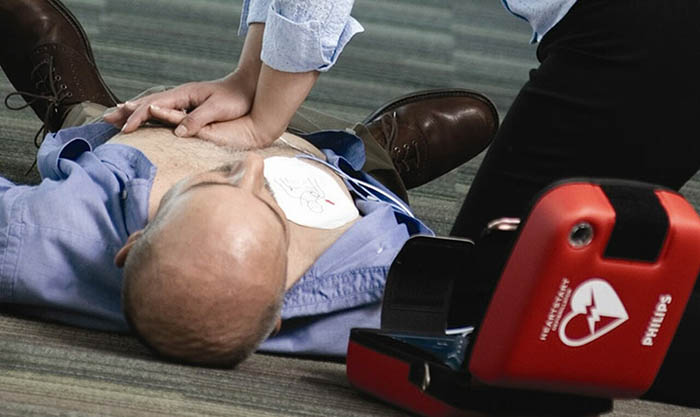
While AEDs are powerful tools, they work best when combined with CPR. High-quality chest compressions maintain minimal blood flow to the brain and heart while someone retrieves an AED. This circulation keeps vital organs viable and actually makes defibrillation more likely to succeed.
The recommended approach is to start CPR immediately, have someone call EKAB (166) and locate an AED, and continue compressions until the device arrives and is ready to use. Growing awareness campaigns by Greek health organizations and the Hellenic Red Cross emphasize this integrated response.
Many newer AED models include CPR coaching features that guide rescuers on compression rate and depth, creating a seamless chain of survival from collapse to professional care.
Critical Statistics: The Numbers That Matter
- 10% Drop Per Minute: Survival chance decreases by approximately 10% for each minute without defibrillation
- 70% Potential Survival: With immediate defibrillation and CPR, survival rates can reach 70%
- Less than 10%: Survival chance if emergency services arrive after 10+ minutes without bystander intervention
- Thousands Affected: Annual out-of-hospital cardiac arrests across Greece
- Urban-Rural Divide: Significant variation in AED availability between cities and remote areas
Progress and Future Directions in Greece
Greece has made strides in recent years toward improving out-of-hospital cardiac arrest outcomes. Legislative efforts have focused on mandating AED placement in certain public venues, schools, and sports facilities.
Training programs through organizations like the Hellenic Resuscitation Council and Greek Red Cross are expanding public knowledge of CPR and AED use. However, challenges remain, particularly in ensuring adequate coverage across Greece’s numerous islands and remote areas.
Out-of-hospital defibrillation represents one of the most significant advances in emergency medicine. By placing life-saving technology in public spaces across Greece—from Syntagma Square to remote island communities—and empowering everyday people to respond to cardiac emergencies, the potential to save Greek lives continues to grow.
Conclusion: A Community-Based Approach to Saving Lives
As AED access expands and more citizens learn to recognize cardiac arrest and act without hesitation, Greece moves closer to European standards in cardiac arrest survival. The combination of technology accessibility, public education, and legal protection creates a powerful framework for community-based emergency response.
Every citizen trained in CPR and AED use, every public space equipped with a defibrillator, and every successful resuscitation represents progress toward a safer, more prepared Greece. The message is clear: in cardiac arrest, immediate action saves lives, and every one of us can be a lifesaver.
⚕️ Sources and Medical References
- Hellenic Society of Cardiology: Cardiac Arrest Guidelines and Statistics (www.hscard.gr)
- EKAB (National Center for Emergency Care): Emergency Response Protocols
- Hellenic Red Cross: First Aid and AED Training Programs
- European Resuscitation Council: National Resuscitation Guidelines
- Hellenic Resuscitation Council: Public Access Defibrillation Initiatives
Get Trained: How You Can Help Save Lives
Cardiac arrest can happen to anyone, anywhere, at any time. Being prepared means knowing how to respond. Consider taking a CPR and AED training course through one of these organizations:
- Hellenic Red Cross: Offers regular first aid, CPR, and AED training sessions across Greece
- Hellenic Resuscitation Council: Provides specialized resuscitation training for healthcare professionals and the public
- Local Municipalities: Many Greek municipalities now offer free or low-cost CPR/AED training to residents
- Workplace Programs: Advocate for AED placement and staff training in your workplace
⚕️ Important Disclaimer
This article is intended for informational purposes only. It does not replace professional medical advice, diagnosis, or treatment. Always consult with qualified healthcare professionals regarding your health. Never alter your treatment plan without medical guidance.
In the event of an emergency, contact local emergency services or visit the nearest hospital immediately. This website and its authors are not liable for outcomes resulting from reliance on the content herein. Readers must take full responsibility for their medical decisions.