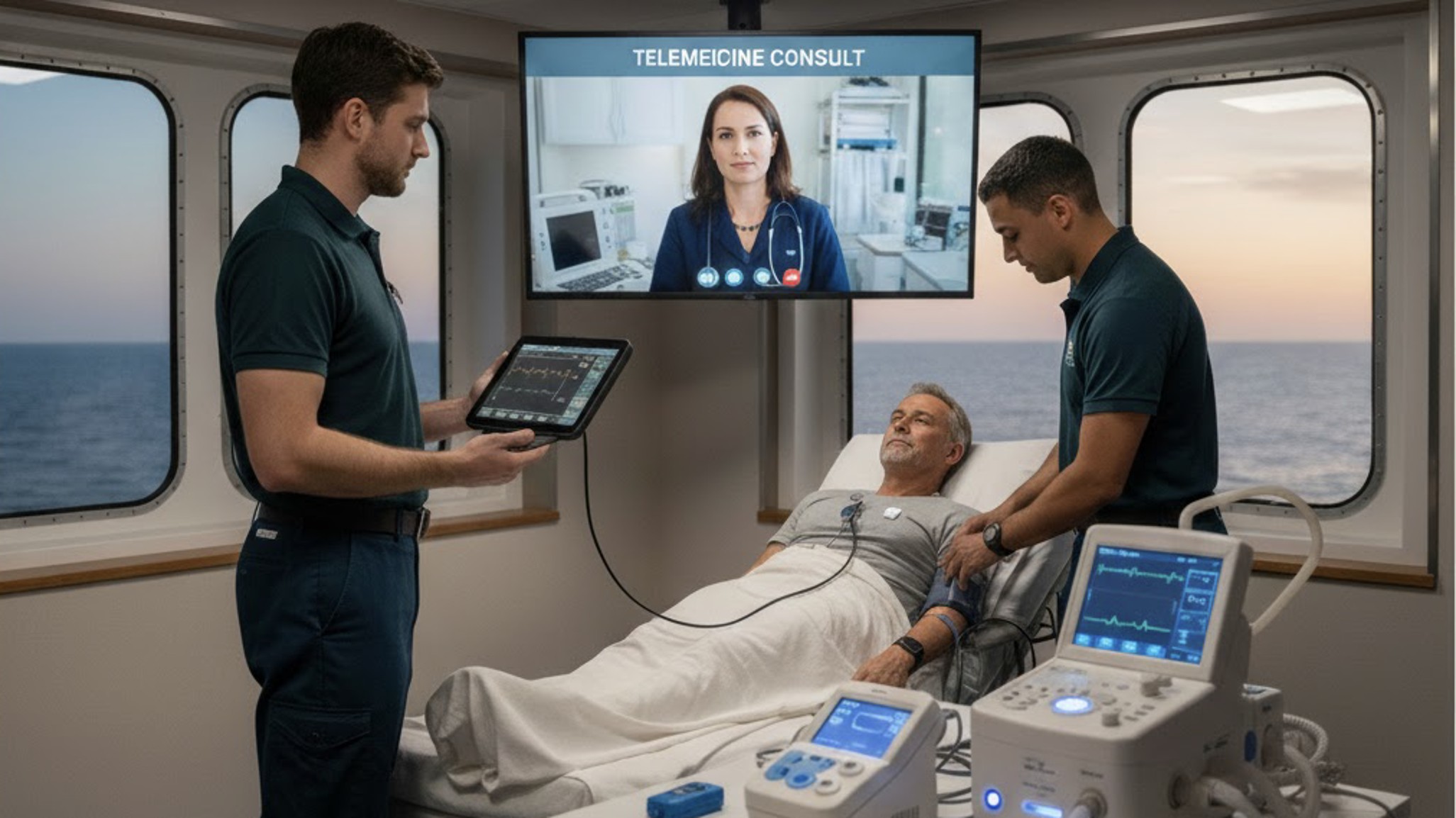
When a medical emergency strikes at sea, every second counts. Commercial vessels operating far from shore face unique challenges in managing crew health, often navigating hundreds of miles from the nearest medical facility. For shipping companies, the stakes are high: medical emergencies can result in costly diversions, crew incapacitation, and in worst-case scenarios, loss of life.
Today, however, advances in portable diagnostic technology and telemedicine are revolutionizing maritime medical care, transforming how vessels manage on-board health risks.
The Maritime Medical Challenge
Commercial shipping crews face a distinct healthcare paradox. While maritime work involves physical demands and potential hazards that increase medical risk, vessels at sea operate in isolation from traditional healthcare infrastructure. A 2019 study published in the International Maritime Health journal found that cardiovascular events and traumatic injuries represent the most common serious medical emergencies at sea, with response times often measured in days rather than minutes.
The International Labour Organization’s Maritime Labour Convention requires vessels to carry medical supplies and equipment appropriate to the voyage, yet until recently, diagnostic capabilities remained limited. Ship officers with basic medical training had to make critical decisions with minimal diagnostic information, often relying solely on radio medical advice from shore-based physicians who couldn’t examine the patient.
The Portable Diagnostics Revolution
Modern portable medical devices are changing this equation dramatically. Compact, durable, and increasingly sophisticated, these tools bring hospital-grade diagnostics to the ship’s medical locker.
Cardiac Monitoring: CardioSecur Pro
CardioSecur Pro
Cardiovascular emergencies represent one of the most serious medical risks at sea. The CardioSecur Pro addresses this challenge with a clinical-grade, portable ECG system that weighs less than 200 grams. Unlike traditional 12-lead ECG machines that require extensive training and bulky equipment, the CardioSecur Pro uses a unique 4-electrode system that can be applied quickly, even by personnel with basic training.
What sets this device apart for maritime use is its ability to provide 12 or 22-lead ECG analysis through proprietary VECG technology, offering more comprehensive cardiac assessment than traditional 12-lead systems. The device connects to a smartphone or tablet, allowing the ECG data to be immediately transmitted to shore-based cardiologists via telemedicine platforms.
Emergency Defibrillation: Philips HeartStart FRx
Philips HeartStart FRx
When cardiac arrest occurs, survival depends on rapid defibrillation. The Philips HeartStart FRx is specifically designed for challenging environments like those found aboard vessels. Its rugged construction withstands harsh conditions, including exposure to water and dust, with an IP55 rating that ensures functionality even in demanding maritime environments.
The Philips HeartStart FRx features intuitive voice prompts that guide untrained users through the defibrillation process, significantly reducing the hesitation that can prove fatal in cardiac emergencies. The device automatically adjusts its instructions based on the users actions and includes a specialized infant/child key for treating younger crew members or passengers.
Point-of-Care Testing: Accu-Answer iSAW
Accu-Answer iSAW
Infectious diseases and metabolic conditions can escalate quickly in the confined environment of a ship. The Accu-Answer iSAW multi-parameter testing system brings laboratory-level diagnostic capabilities to the vessel. This portable analyzer can perform rapid tests for various conditions including infectious diseases, cardiac markers, and metabolic panels. Results are available within minutes rather than days, enabling immediate treatment decisions.
Urinalysis at Sea: Contec BC401
Contec BC401
Urinary tract infections, kidney problems, and metabolic disorders can be detected early through urinalysis. The Contec BC401 automated urine analyzer makes this laboratory staple available shipboard. This compact device performs comprehensive urine chemistry analysis, testing for up to 11 parameters including glucose, protein, blood, ketones, and signs of infection.
Telemedicine: Bridging the Distance Gap
Portable diagnostics achieve their full potential when integrated with telemedicine platforms. Modern maritime telemedicine solutions connect vessels with shore-based medical professionals through satellite internet, creating virtual clinics at sea. These platforms enable real-time video consultations, allowing physicians to visually assess patients, observe symptoms, and guide on-board personnel through examinations and procedures.
More importantly, they facilitate the transmission of diagnostic data from devices like the CardioSecur Pro or Accu-Answer iSAW, enabling remote physicians to interpret test results and make informed treatment recommendations. The University of Texas Medical Branch (UTMB), a leader in maritime telemedicine, reports that their remote medical support services reduce unnecessary medical evacuations by up to 30 percent.
Implementing a Comprehensive Maritime Medical Program
- Training and Protocols: Crew members designated as medical officers need training not just in device operation, but in when and how to use each tool.
- Maintenance and Readiness: Maritime environments are harsh on equipment. Regular maintenance schedules ensure devices function when needed.
- Integration with Shore Support: Establish relationships with maritime medical assistance companies that provide 24/7 access to physicians.
- Regulatory Compliance: Align with flag state requirements, IMO guidelines, and industry standards.
The Business Case
Beyond humanitarian benefits, advanced medical capabilities deliver tangible ROI. Medical evacuations cost upwards of $100,000, while diversions average $200,000–$500,000. Programs preventing even one evacuation justify costs, with insurers offering premium reductions.
Protect Your Crew, Secure Your Operations
Invest in portable diagnostics and telemedicine today. Contact maritime medical experts to build your program.
Sources
- International Maritime Health Association (IMHA). Guidelines on Medical Care Aboard Ships.
- International Labour Organization. Maritime Labour Convention, 2006.
- Cardiovascular emergency management at sea. International Maritime Health, 2019.
- University of Texas Medical Branch (UTMB). Maritime Telemedicine Services.
- CardioSecur. CardioSecur Pro Technical Specifications.
- Philips Healthcare. HeartStart FRx Defibrillator Product Information.
This article is provided for informational purposes and does not constitute medical or professional advice.